Pennsylvania Electricity Rates: June 2026 Reset Confirms More Increases
Pennsylvania's June 1 Price to Compare updates confirm another round of default service increases, with several utility territories seeing high-single-digit or double-digit changes.
Competitive supplier pricing and recent procurement results pointed in the same direction. The Pennsylvania PUC has now confirmed that utility default rates will increase again on June 1st, and likely not for the last time.
Setting the Stage on Recent Rate Trends
The utility rate increases over the past year have been well documented. But 12-month offers from competitive suppliers posted on the Pennsylvania rateboard, along with recent utility procurement auction results, are signaling that consumers should be bracing for additional increases ahead.
Utility default service rates tend to reset only twice a year and are based on a layered hedging program that blends procurement tranches purchased over the prior 12 to 18 months. Competitive supplier offers, by contrast, are based on current market prices for future delivery months, including future capacity periods. That makes supplier offers a leading indicator of where utility rates are heading.
Right now, they show rates going up.
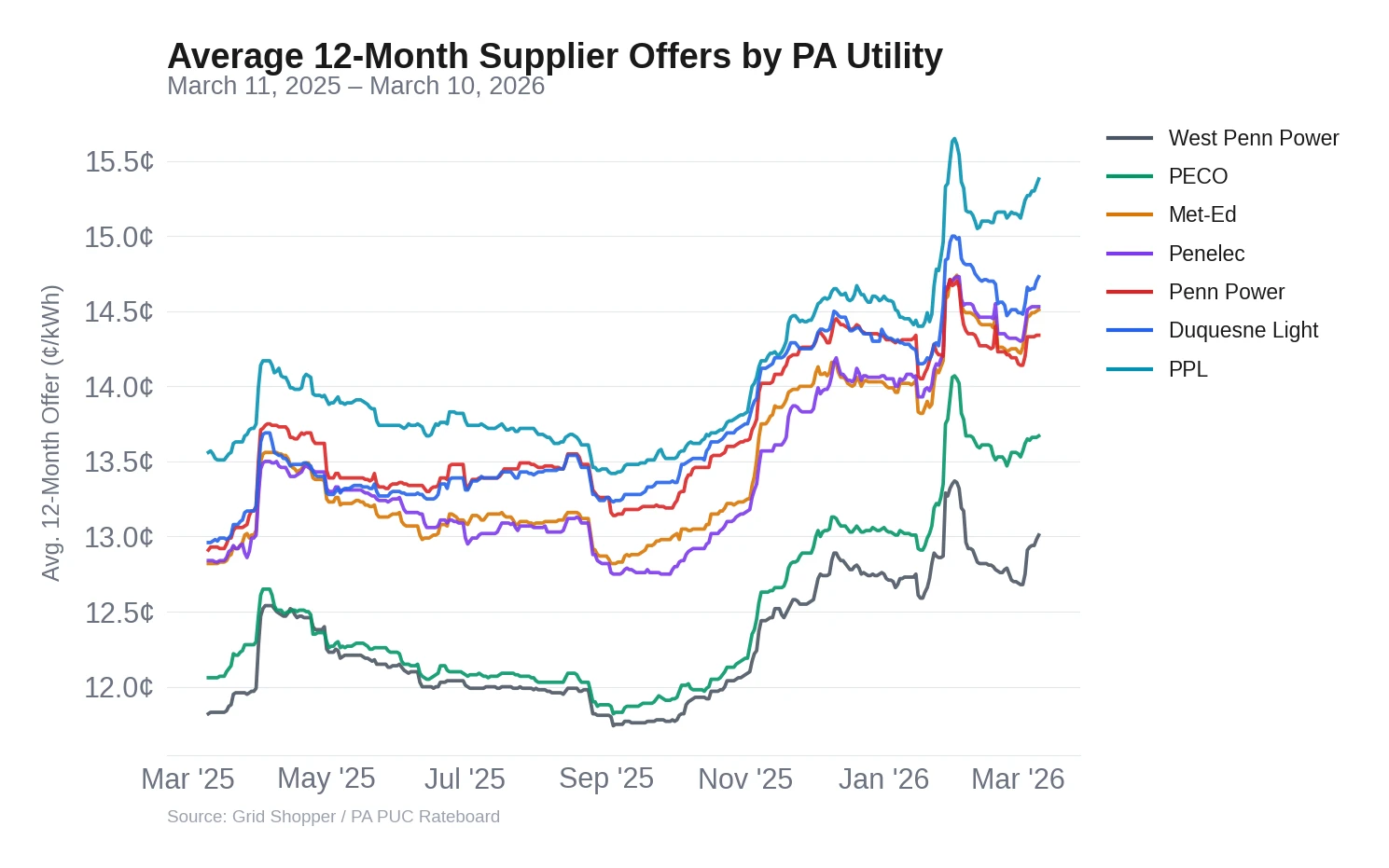
Average 12-month supplier offers have climbed steadily across all seven Pennsylvania utility territories since spring 2025.
Pennsylvania Utilities June 1 Rate Updates Confirmed
The Pennsylvania PUC has now confirmed that most residential default service customers will see higher utility generation rates on June 1, 2026. These changes apply to customers who have not selected a competitive electric generation supplier. Customers already shopping with a supplier continue paying the generation price set by their contract.
| Utility | Current PTC | June 1 PTC | Change |
|---|---|---|---|
| Duquesne Light | 13.75¢ | 14.14¢ | +2.84% |
| Met-Ed | 12.965¢ | 13.951¢ | +7.6% |
| PECO | 11.024¢ | 11.759¢ | +6.67% |
| Penelec | 11.747¢ | 13.142¢ | +11.88% |
| Penn Power | 12.606¢ | 13.477¢ | +6.9% |
| PPL | 12.953¢ | 13.147¢ | +1.5% |
| UGI Electric | 11.212¢ | 12.617¢ | +12.53% |
| West Penn Power | 10.947¢ | 12.075¢ | +10.3% |
Source: Pennsylvania Public Utility Commission June 1 residential Price to Compare update, published May 20, 2026. The PUC lists some values as estimated and also includes smaller utilities not tracked in Grid Shopper’s Pennsylvania utility pages.
PECO · PPL · Duquesne Light · Met-Ed · Penelec · Penn Power · West Penn Power
The confirmed increases range from modest in PPL’s territory to double-digit jumps for Penelec, UGI Electric, and West Penn Power. PECO’s residential Price to Compare rises from 11.024¢/kWh to 11.759¢/kWh, while PPL moves from 12.953¢/kWh to 13.147¢/kWh.
This official update confirms the signal that was visible earlier in the year. As of early March 2026, most Pennsylvania utilities had completed procurement for the June 2026 through December 2026 period. Those auction results pointed to a continued upward trend in utility rates, though the June 2026 increases are still less severe than the June 2025 jump that followed the first major capacity cost shock.
The timing matters. The rates in effect for December 2025 through May 2026 are a blended average of tranches purchased over the prior 12 to 18 months. Many of those tranches were locked in when wholesale prices were lower and when capacity costs still reflected the less expensive 2025-2026 delivery year.
The new rates starting June 1 still include some earlier, cheaper supply, but they will also incorporate newer procurement at materially higher costs. So even after Pennsylvania utilities move to their June 2026 default service rates, those numbers may still lag current market conditions.
For background on the PJM capacity auction results that drove last year’s increases, see Grid Shopper’s PJM capacity auction analysis.
What Does the Competitive Market Tell Us?
As of March 2026, competitive 12-month fixed-rate offers are at or above the current utility default service rate in most Pennsylvania utility territories. A few territories may show one or two offers slightly below the line, but broadly the market is not offering consumers a way to beat the current utility rate on a full 12-month term.
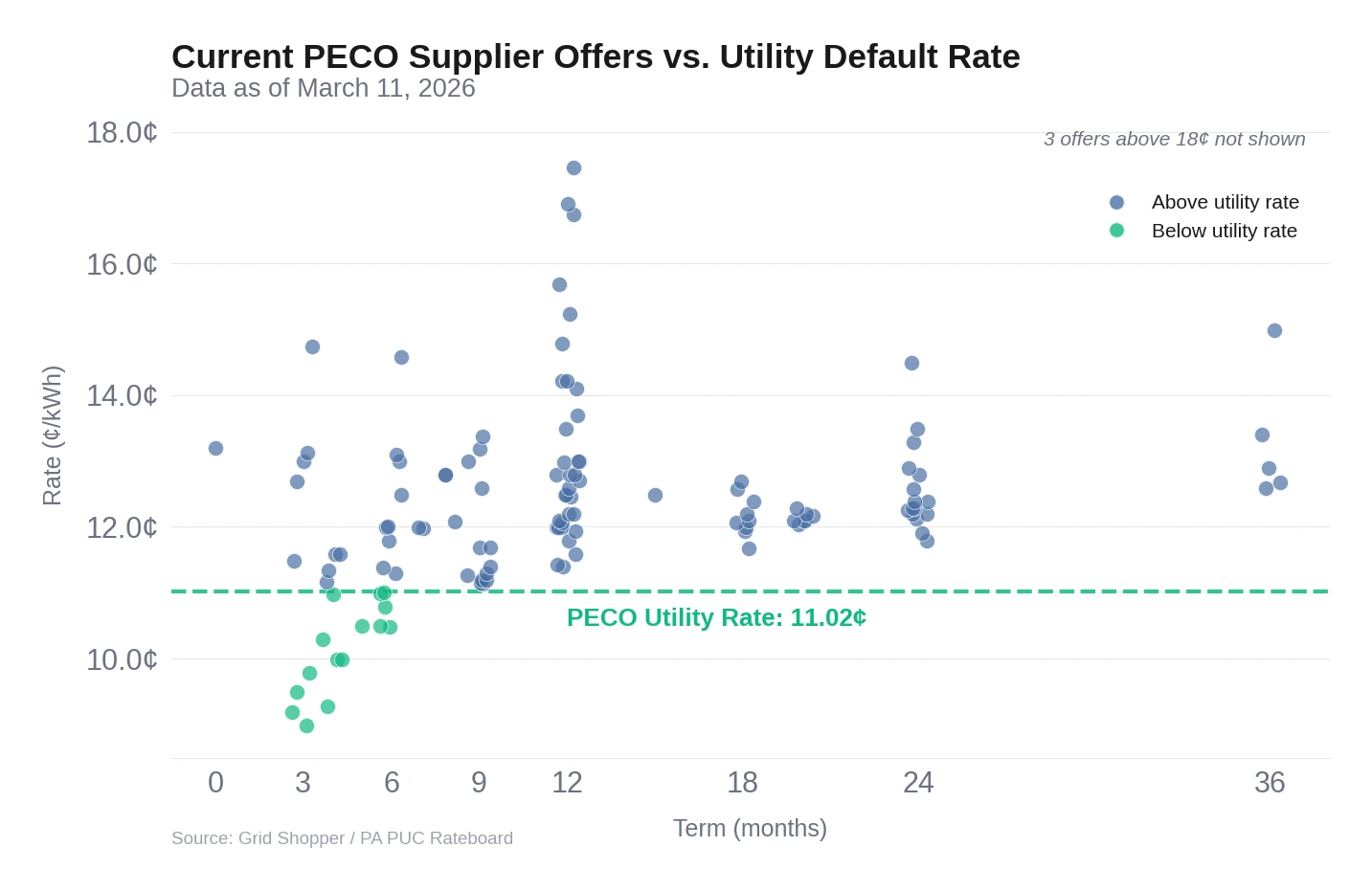
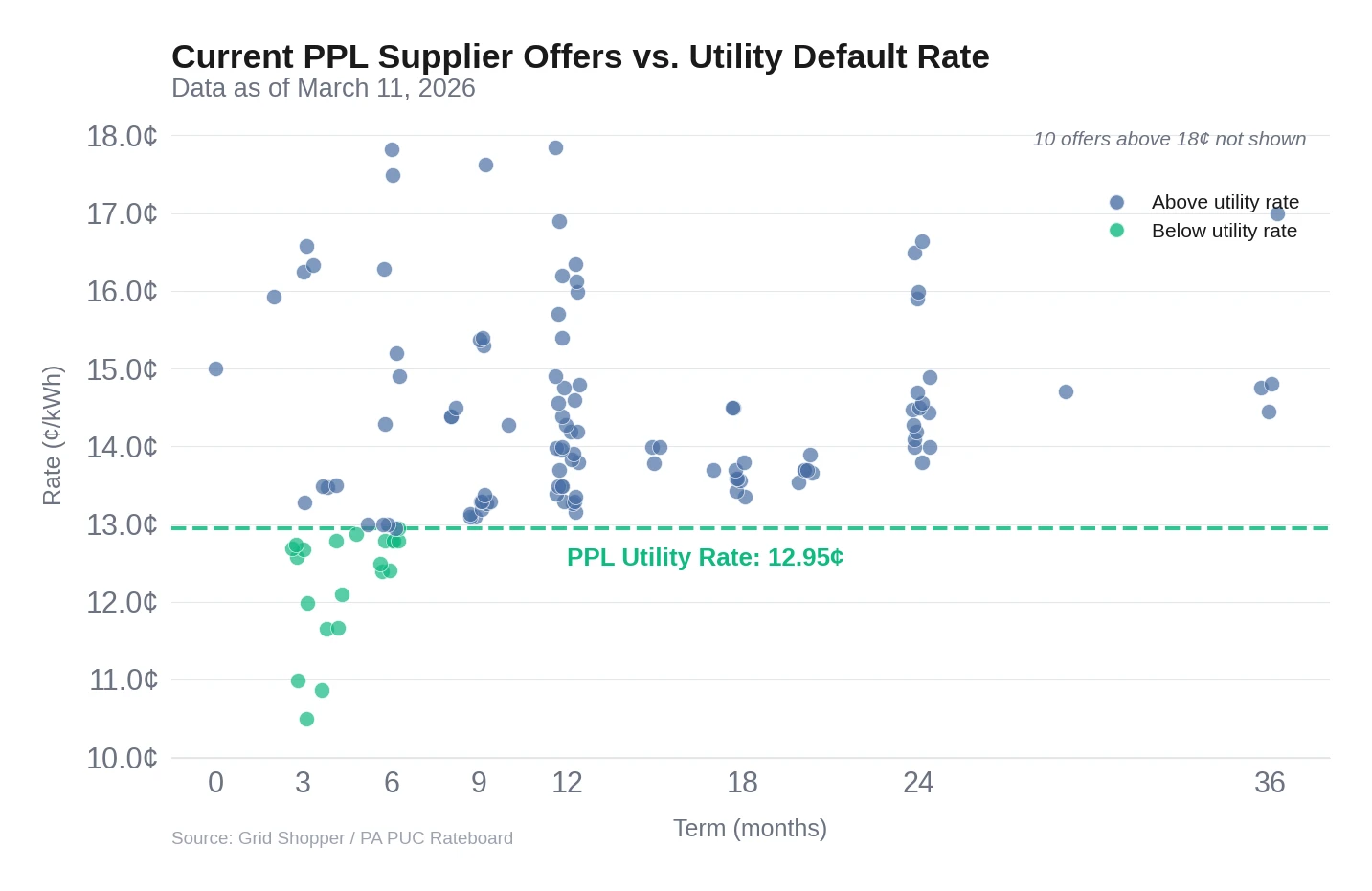
For live offer data, readers can use the utility pages directly or compare broader supplier pricing on the market trends page.
The reason comes down to a timing mismatch. When a supplier prices a 12-month offer in March 2026, it is pricing power for roughly April 2026 through March 2027. That period includes about nine months of the more expensive 2026-2027 PJM capacity delivery year and is built off today’s higher forward energy market. Current utility rates, by contrast, reflect supply that was priced months ago for a service period that is almost over.
The only offers currently below the utility line tend to be very short-term deals lasting two or three months, with contract end dates before the more expensive capacity year and peak summer period are fully in effect.
The competitive market is already reflecting a more expensive forward period that has not fully shown up in current utility rates yet. When the June 1 reset brings utility default service closer to current procurement costs, the gap between default service and competitive offers should narrow, but the overall price level will be higher for everyone.
What Is Behind the Continued Rate Increases
Two compounding forces are pushing rates higher: capacity and wholesale energy.
Capacity charges step up again. PJM capacity charges increase again on June 1, 2026 for Pennsylvania utilities. The step-up is far smaller than the historic jump that hit June 2025 bills, but it still adds meaningful cost on top of an already elevated baseline. This is now the second consecutive year of significant capacity cost pressure. For a summary of the 2026-2027 PJM auction results, see Enel North America’s recap.
Wholesale energy prices are also elevated. Forward power prices across PJM have risen over the past year as supply-demand conditions tighten. Like the capacity story, higher forward energy pricing reflects extraordinary load growth, uncertainty about the timing of new generation, and continued friction in bringing new resources online.
Last year, the story was capacity. This year, it is capacity and energy.
Where Is the New Demand Coming From
Data centers.
Pennsylvania has become one of the fastest-growing states for data center development, and PJM’s load forecasts have been revised sharply upward to account for expected large-load growth. That demand has become central to the electricity cost conversation because it lands on top of an already constrained regional power market. For background, see the Pennsylvania data center investment tracker and PJM’s 2026 load forecast report.
Public sentiment toward AI infrastructure has become more skeptical as the link between data center power consumption and rising household electricity bills gets more attention. Governor Josh Shapiro acknowledged that tension in early 2026, saying Pennsylvania needs to be selective about which projects move forward in his February 2026 budget remarks. Lawmakers in Harrisburg have also advanced proposals around data center zoning, water impacts, large-load cost responsibility, and local oversight, as covered by City & State Pennsylvania.
What Is Being Done to Help Consumers
Governor Shapiro has been the most aggressive governor in the PJM footprint on electricity cost issues, but nearly all of that work has been aimed at wholesale market structure rather than near-term retail bill relief.
The price collar. In December 2024, Shapiro sued PJM over its capacity auction design. That fight helped produce a settlement establishing a price cap on the auction, later approved by FERC and then extended further into future delivery years. Those measures likely prevented even larger price spikes, but they represent avoided increases, not reductions from prior consumer bills. The Pennsylvania Capital-Star reported on the extension of that price cap framework.
Cost causation for data centers. A January 2026 statement of principles signed by Shapiro, other governors, and federal officials called for assigning the cost of new long-term capacity contracts to large new loads such as data centers rather than broadly socializing those costs across households and small businesses. If adopted, that would help limit future increases. It would not lower the current baseline. The document is available from the U.S. Department of Energy.
Load forecast accountability. New Pennsylvania law also gives the PUC authority to review and validate utility load forecasts submitted to PJM. That matters because utilities have a financial incentive to attract large loads like data centers into their territories, which grows their rate base. That creates a risk that utilities overstate feasible demand growth in their forecasts, or count projects that are shopping for interconnection across multiple utility territories as incremental load in each one. Inflated load forecasts feed directly into PJM’s capacity demand curve, which in turn drives higher auction clearing prices. The Kleinman Center for Energy Policy at the University of Pennsylvania has a useful writeup on the ratepayer rationale behind that law.
These are meaningful actions aimed at protecting consumers from future rate increases, though unlikely to lower bills in the near term.
What Can Consumers Do
Consumers on default utility service should expect a rate increase on June 1, 2026. Shopping may make more sense after that reset, when the utility benchmark is more aligned with the current forward market. In the meantime, consumers should review whether they are still on default service or a competitive supplier plan that may be expiring soon.
Grid Shopper will continue tracking supplier offers and updated default service rates across Pennsylvania utility territories:
PECO · PPL · Duquesne Light · Met-Ed · Penelec · Penn Power · West Penn Power
The Bigger Picture
Most coverage of rising electricity costs relies on backward-looking data: trailing utility rate changes, government reports published after the fact, or year-over-year bill comparisons. That kind of analysis tells consumers where they have been. It does not tell them where they are going.
Competitive retail offers tell a different story. Supplier pricing is based on the current forward wholesale market for future delivery periods, including future PJM capacity years. When those offers are consistently above the current utility default rate across Pennsylvania territories, they reveal the structural lag built into utility pricing.
Utility rates blend procurement purchased over time. Supplier offers represent a current snapshot of the market. In a period where wholesale energy is rising and future capacity years are more expensive than the current one, utility rates will trail market conditions.
That is the gap Grid Shopper is built to cover. Utility rates are a lagging indicator. Historical public reporting is a lagging indicator. Competitive supplier offers, tracked continuously across Pennsylvania utility territories, are as close to a leading indicator as consumers can get. Right now, they are signaling that Pennsylvania electricity prices have not finished adjusting upward.
Readers can follow live supplier offers on the market trends page and on each utility-specific page listed above.